
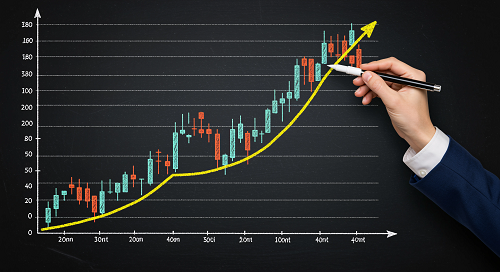
When potential earnings are generated in long-term investing, an investor has two options: withdraw them or reinvest them. This decision may be shaped by one’s changing income levels, liquidity needs, and evolving financial priorities. However, over time, this can impact how an investment develops.
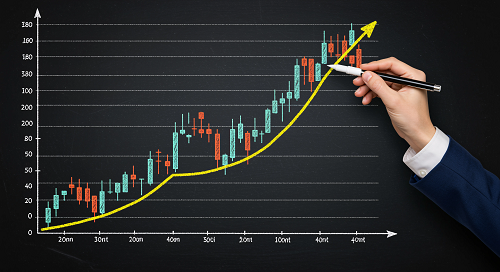 |
A compound interest calculator helps you visualize the power of compounding
A compound interest calculator offers a structured way to examine this behaviour. By placing reinvestment and withdrawal scenarios side by side, it helps illustrate how potential outcomes may differ as time progresses.
This approach may support understanding of how reinvestment interacts with time in a long-term investing context. Such tools may be used for comparison and illustration and not for predicting potential conclusions.
Reinvestment as a repeated choice
Reinvestment refers to allowing interest, dividends, or gains to remain invested instead of being withdrawn. In the short-term, this choice may not appear to alter much. Over longer periods, however, its influence may become more noticeable with each reinvestment cycle. This process may be particularly relevant in market-linked investments, where potential returns are uneven and distributed across cycles.
Compounding has the potential to be more effective when investments remain invested for longer durations. Discussion around compounding may revolve around consistency and on how it functions across extended periods, rather than on frequent action.
Visualising reinvestment using a compound interest calculator.
Because compounding unfolds gradually, its effects may not be intuitive. A compound interest calculator may help translate this process into comparable figures.
For example, when earnings are withdrawn periodically, the investment may have less capital available for compounding, which can limit long-term growth. When earnings are reinvested instead, the base amount increases over time, allowing compounding to potentially accelerate the growth trajectory. Comparing these scenarios could help investors observe how reinvestment could influence potential outcomes, even when calculation assumptions remain unchanged.
Actual results may vary from the calculations as they’re only illustrative and not conclusive. Instead, they provide a way to explore how different behavioural choices may interact with time.
The calculator is an aid, not a prediction tool. It may provide only an indicative picture.
The power of compounding
The power of compounding describes how potential earnings, when retained, may generate additional potential income over time. As this process repeats, its effect might become more visible across longer periods, particularly when reinvestment remains uninterrupted.
In investment discussions, the power of compounding may commonly be associated with:
Long-term equity investments.
Retirement-focused planning.
Regular investment approaches that place importance on discipline.
These associations arise because time and consistency play a central role in compounding. However, compounding does not operate independently of potential risk or market variability.
Compounding neither reduces uncertainty nor guarantee favourable outcomes. Market-linked investments remain subject to risks. However, the power of compounding gives investments the potential to grow significantly in the long run.
How withdrawals influence the pattern
When potential earnings are withdrawn, part of the compounding process is interrupted. This does not suggest that withdrawals are inappropriate, as individual financial needs may vary across life stages. From a numerical perspective, however, withdrawals reduce the potential amount that remains available for future compounding.
A compound interest calculator may help compare scenarios with and without withdrawals. Over extended periods, even relatively modest interruptions may lead to noticeably different outcomes. These differences may become relatively clearer when viewed across longer horizons rather than shorter intervals.
The impact of withdrawals is therefore less about timing individual decisions and more about how frequently the compounding process is allowed to continue uninterrupted.
Conclusion
Reinvestment does not imply certainty of potential results. It represents a framework shaped by time, behaviour, and potential expectations. By understanding the power of compounding and using a compound interest calculator to visualise different scenarios, investors may gain insight into how repeated decisions might potentially accumulate over long horizons.
In some cases, the decision to reinvest may not feel significant at the moment it is made. Over longer periods, its effects may become more visible as potential outcomes gradually take shape, without requiring relatively frequent intervention.
Mutual Fund investments are subject to market risks, read all scheme related documents carefully.


