
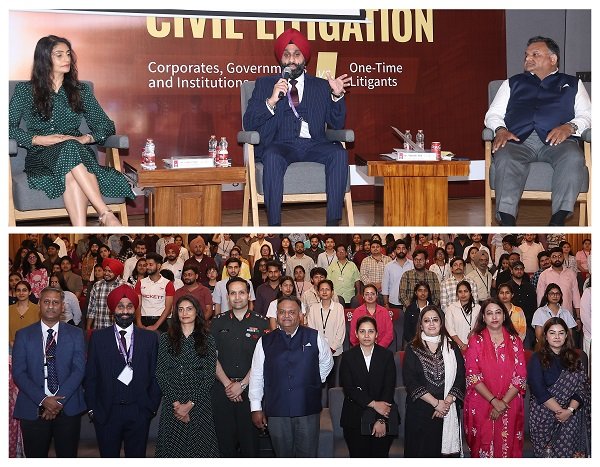
International Lawyers Participate in ‘Rise of the Powerful Repeat Player in Civil Litigation’ Panel Discussion ; organized by Punjab & Haryana High Court at Chandigarh University as part of ‘India International Disputes Week 2026’
UK-based Solicitor Lakhvir Singh says Experience Influences Pre-litigation Strategy but outcomes Depend on Merits of the Case
A distinguished panel of international lawyers, solicitors, arbitrators and prominent legal luminaries and scholars participated in a high-level panel discussion on ‘Rise of the Powerful Repeat Player in Civil Litigation: Corporates, Governments and Institutions vs One-Time Litigants’ organized by the Punjab and Haryana High Court in collaboration with Chandigarh University as part of India International Disputes Week 2026. The initiative was aimed at strengthening India’s position as a credible global hub for dispute resolution across litigation, arbitration and mediation to encourage institutional collaboration and cross-border legal engagement.
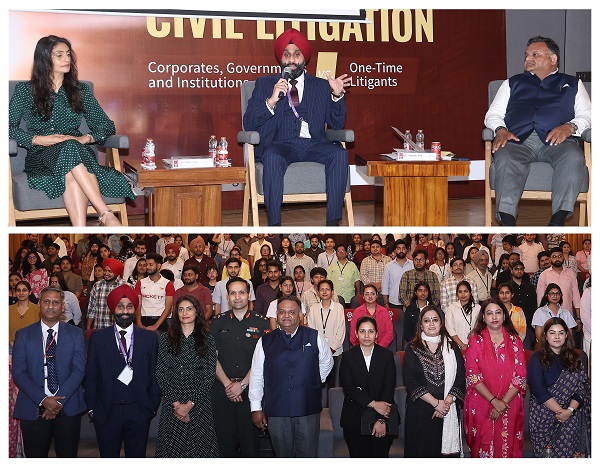 |
Prominent International lawyers, solicitors, arbitrators & legal luminaries speaking during ‘Rise of the Powerful Repeat Player in Civil Litigation’ Panel discussion at Chandigarh University
Chandigarh University hosted the panel discussion that brought together leading legal luminaries, practitioners and scholars who deliberated on emerging trends in civil litigation and dispute resolution. The discussions particularly highlighted the increasing dominance of institutional litigants including governments, corporations and public bodies in contemporary justice systems and examined the implications of this trend for individuals and one-time litigants. The discussion focused on how such ‘repeat players’ often accumulate greater legal expertise, advantages and institutional resources through frequent engagement with courts and tribunals while individual or one-time litigants find themselves at a systemic disadvantage.
The prominent among those who were present during the panel discussion were Lakhvir Singh, Solicitor at Alexander & Co Solicitors LLP, Nottingham (UK), Gurprit Mattu, Commercial Litigation Barrister and Mediator, London, Manish Jain Senior Advocate at the Punjab and Haryana High Court, Aman Pal, Senior Advocate at the Punjab and Haryana High Court and Prof (Dr) Ashutosh Hajela, Executive Director, University Institute Legal Studies (UILS). The panel was moderated by Amanat Kahlon, Assistant Professor, University Institute Legal Studies (UILS).
Speaking during the panel discussion, Lakhvir Singh, Solicitor at Alexander & Co Solicitors LLP, Nottingham, UK, said, “In jurisdictions like the UK, repeat or institutional litigants often develop a better understanding of how to manage litigation, particularly when it comes to mitigating risks and controlling the costs associated with legal proceedings. Because they engage with the system frequently, they are generally more aware of when it is sensible to proceed with litigation and when it may be more appropriate to resolve a dispute outside court. However, our system is largely governed by the Civil Procedure Rules and the protocols that operate within them, which are designed to create a structured and predictable process. These rules to a large extent help balance the system because they apply equally to both repeat litigants and one-time litigants, ensuring that while experience may provide some advantage, the procedural framework aims to make the process fairer and more manageable for all parties involved.”
“While institutional litigants may have greater financial resources, outcomes in courts are ultimately decided on the merits of the case, the evidence and the strength of legal arguments. Experience mainly matters at the pre-litigation stage, where repeat litigants better understand procedural nuances for example, a landlord with multiple properties is more likely to know the correct legal steps when a tenant defaults on rent, while a first-time litigant may unknowingly waive certain rights. However, once the matter reaches court, the judge decides the case strictly on law and evidence,” added Singh.
Gurprit Mattu, Commercial Litigation Barrister and Mediator, London said, “Early mediation can level the playing field because neither party has yet incurred heavy legal costs. In many commercial disputes, particularly shareholder disputes, prolonged litigation can damage the very business the parties are trying to protect. Over the past few years mediation in England has grown significantly mainly due to the potential cost implications that come with litigation. Even if a party wins a case, the court can order the losing party to pay a substantial portion of the winner’s legal expenses sometimes up to 70 to 80 percent along with interest. Because of these potential costs, parties increasingly consider mediation at a very early stage of the dispute often even before a case is formally filed in court.”
“Arbitration is closer to a court process where arbitrators eventually deliver a judgment. It can still take years and involves legal costs. Mediation usually happens in a single sitting or within a short period and can resolve disputes much more quickly,” added Mattu.
Manish Jain Senior Advocate at the Punjab and Haryana High Court said, “In practice an individual litigant is often at a disadvantage when compared to large corporations or institutional parties. These entities have the resources, legal teams, and networks to pursue prolonged litigation and multiple appeals whereas for an individual the cost, time and effort involved can be overwhelming. Cases can take years to move through the system and even after winning, a litigant may have to initiate separate execution proceedings to enforce it. Imposing meaningful costs on losing parties could help curb frivolous litigation and reduce unnecessary burdens on the judicial system.”
Aman Pal, Senior Advocate at the Punjab and Haryana High Court said, “Strategy goes a long way in litigation. Over time, you learn how to mitigate risks involved in litigation and also how to control the costs associated with pursuing a case. Repeat or institutional litigants, because of their continued exposure to the legal system, often develop a clearer understanding of these aspects. They are generally better placed to assess the situation and determine when it is worthwhile to initiate or pursue litigation and when it may be more prudent to avoid it. This experience often shapes a more informed and strategic approach to handling disputes.”
Prof (Dr) Ashutosh Hajela, Executive Director, UILS said, “The panel discussion on the rise of the powerful repeat player in civil litigation was highly insightful and fruitful where legal luminaries deliberated on systemic challenges and emphasized the need for strengthening fair and efficient dispute resolution mechanisms. The discussion yielded major takeaways on promoting mediation, reducing litigation and encouraging institutional reforms to enhance access to justice. The deliberations were well appreciated by students, young and budding lawyers, faculty members and all attendees. Such initiatives continue to encourage practical legal understanding and policy-oriented thinking among students. Chandigarh University organizes such events to bridge the gap between academic learning and real-world legal practice, equipping students with practical insights and policy-oriented perspectives.”
Chandigarh University
Chandigarh University is a NAAC A+ Grade University and QS World Ranked University. This autonomous educational institution is approved by UGC and is located near Chandigarh in the state of Punjab. It is the youngest university in India and the only private university in Punjab to be honoured with A+ Grade by NAAC (National Assessment and Accreditation Council). CU offers more than 109 UG and PG programs in the field of engineering, management, pharmacy, law, architecture, journalism, animation, hotel management, commerce, and others. It has been awarded as The University with Best Placements by WCRC.
Website address: www.cuchd.in.


