
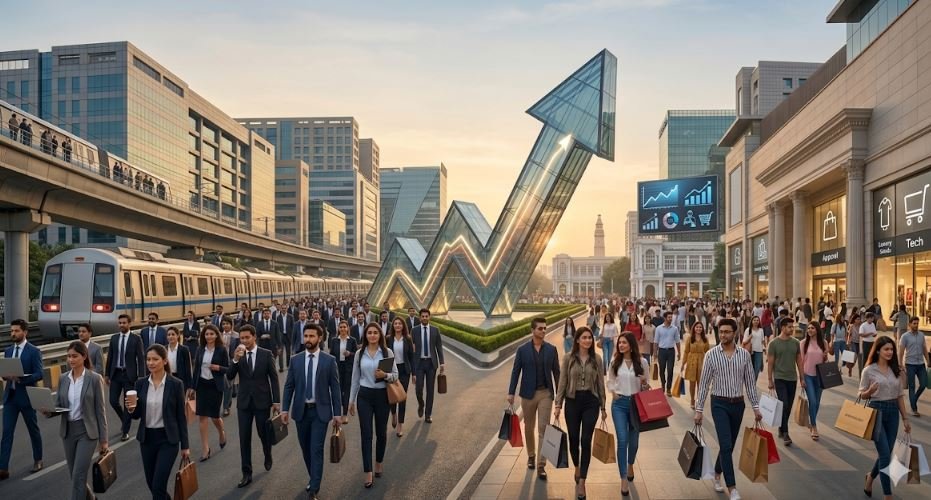
Somewhere between the second espresso bar opening on a lane in Gurugram and a European fashion label quietly locking a lease in South Delhi, the retail rental story in Delhi-NCR has shifted again. Not dramatically, but unmistakably. Rents are rising, yes, but the more telling detail is who is willing to pay them. Increasingly, that willingness is being reinforced by a parallel recovery in office markets, where rising corporate occupancy, return-to-office trends, and clusters of Grade-A workplaces are steadily rebuilding the daily consumer base that sustains high street retail.
 |
Delhi-NCR is creating a high-growth commercial ecosystem that continues to push prime rentals higher in 2026
According to a recent study by Cushman & Wakefield, retail rents across Delhi-NCR’s prime high streets increased between 2% and 14% through 2025, with Khan Market recording roughly 8% growth and Gurugram’s Galleria Market rising nearly 14% year-on-year. The numbers themselves are modest; the persistence behind them is what the market notices. Besides, office leasing across NCR has regained momentum over the past year, bringing with it a more consistent weekday population back into key urban pockets. In markets like Gurugram and Noida, where large office clusters sit in close proximity to high streets, this return has begun to directly influence retail performance.
Data from JLL indicates that retail leasing across India’s top cities grew 54% in 2025, with Delhi-NCR emerging as one of the dominant markets for new store expansion. Developers know that modern retail space is not merely about area; it is about curation.
Jatin Goel, Executive Director, Omaxe Group, said, “A mall or high street must function as a lifestyle environment, not just a collection of stores. In emerging micro-markets like Faridabad, the retail ecosystem has matured into something far more experience-driven than it was even five years ago. Consumers are no longer coming only to shop; they are coming to spend time. Projects that integrate experiential shopping, open promenades and event-driven retail tend to sustain stronger footfall. That, in turn, allows retailers to justify higher rentals because the environment supports longer consumer engagement.”
At a broader level, this momentum is visible across India. CBRE estimates that India recorded nearly 8.9 million sq ft of retail leasing in 2025, one of the highest absorption levels in recent years.
Arjun Gehlot, Director, Ambience Malls, said, “Retail has become far more strategic. Brands now evaluate the ecosystem around a retail project, nearby offices, residential communities, and transit connectivity. When those factors align, rentals tend to rise naturally because retailers are investing in long-term brand positioning rather than short-term store economics.”
Old Gurgaon illustrates the point rather neatly. For years, it was considered a legacy retail zone, stable but unremarkable. Now, with steady residential density and office catchments nearby, the area has begun attracting a different retail mix. Restaurants stay open later. Apparel brands test new formats. Weekends feel crowded again.
Mitul Jain, Managing Director, SPJ Group, said, “At first glance, rising retail rents appear like a straightforward demand story. But the deeper shift is that organised retail environments are becoming fewer and more specialised. When retailers find a location that works, with the right catchment and dwell time, they hold onto it. That behaviour tightens supply in ways that statistics sometimes fail to capture.”
Connaught Place still feels fully saturated. Khan Market remains impossibly expensive. But other pockets, parts of Noida, certain sectors of Gurugram, are still searching for the right retail chemistry. For developers, this shift is also changing how projects are evaluated.
Harinder Singh Hora, Founder Chairman, Reach Group, said, “In NCR, rental growth is increasingly being driven by the convergence of retail and office demand. While international brands initially secure space in high-visibility retail destinations, their expansion into emerging micro-markets coincides with growing office absorption in these corridors. This dual demand creates a strong ecosystem of working professionals and active consumers, leading to sustained footfall and a steady upward movement in rentals across both prime and secondary locations.”
This shift is even more visible in emerging office-led markets like Noida. Another report, “Noida-Runway for Growth”, from Cushman and Wakefield, showed how Noida has also witnessed a significant 40% increase in investment-grade office assets, attracting multinational corporations and strengthening its dynamic business ecosystem.
Dr. Amish Bhutani, Managing Director, Group 108, said, “As Noida and Greater Noida continue to evolve, what we are witnessing is a strong convergence of Grade-A office and curated retail development, particularly along the Noida Expressway. With MNCs and international brands steadily establishing their presence and infrastructure catalysts, like the Noida International Airport, enhancing regional connectivity, these corridors are emerging as balanced, high-growth commercial ecosystems. This synergy between workplaces and retail is creating sustained, all-day demand, encouraging brands to commit to high-quality spaces early and for the long term, which in turn is supporting both rental resilience and overall market stability.”
Raj Kumar Sisodia, COO, Biigtech, added, “In Noida-Greater Noida, we have observed that retail works best when it is planned alongside strong office ecosystems. The presence of Grade-A office spaces is creating a steady and predictable consumer base, which naturally strengthens retail performance. For us as developers, this integration is important because workplaces bring consistent, weekday-driven footfall, allowing retail environments to remain active through the day. It ultimately leads to more sustainable leasing and better long-term value creation across the project.”
What sits beneath this steady rental movement is a broader commercial recovery that is less immediately visible but equally consequential. The expansion of high-quality office space reflects strong investor confidence and sustained demand from occupiers.


