

The Telangana Rising 2047 Global Summit brought together policymakers, industry leaders, and global experts to chart a long-term vision for the state’s inclusive and sustainable growth. Organized by the Government of Telangana, the summit focused on the future of urban development, economic expansion, and equitable access to housing. As real estate plays a crucial role in shaping the state’s urban transformation, the sessions dedicated to affordable housing saw strong participation from both government and private-sector representatives.
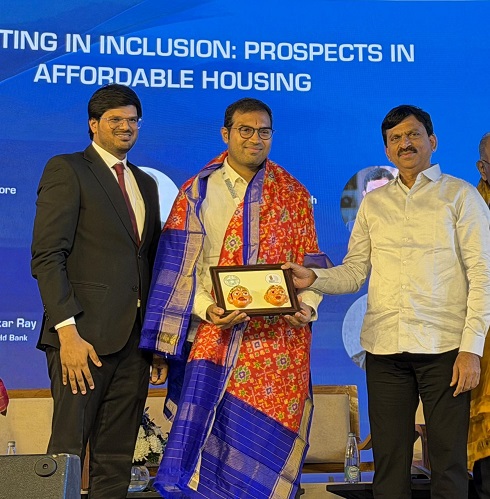 |
Ajitesh Korupolu, Founder & CEO of ASBL with Sri Ponguleti Srinivas Reddy, Hon’ble Minister for Revenue, Housing, and Information & PR, at the Telangana Rising 2047 Global Summit
ASBL’s Founder and CEO, Ajitesh Korupolu, was invited as one of only two developers from Hyderabad to join the distinguished panel discussion on “Investing in Inclusion: Prospects in Affordable Housing.” The conversation explored how Telangana can address the growing demand across EWS, LIG, MIG, and rental segments while encouraging private sector participation. Ajitesh brought a data-driven and structural perspective to the discussion, beginning with the need for the government to simplify the land side of the ecosystem, particularly in core city areas where the government holds significant greenfield and brownfield parcels. He emphasized that slum lands, which today informally serve affordable demand, can become strong formal housing assets if ownership structures are streamlined. He also highlighted how Hyderabad’s high-FSI regime is a key reason the city remains one of India’s most affordable metros, comparing per-sq-ft costs with cities like Bengaluru and Gurugram to showcase Hyderabad’s relative strength.
Building on this, Ajitesh stressed that future affordable housing models must balance ownership and rental pathways. With rising EMIs and limited financial bandwidth among households earning under INR 10-12 lakhs annually, he argued for a structured rental housing model supported by cap rates of 7-8%, backed by global institutions like IFC and ADB that already fund such initiatives. He emphasized that government innovation should focus on land ownership reforms, while developers must invest in R&D and construction efficiency. Speaking about technology, he noted that prefabrication is likely to become the most viable future solution for large-scale housing, provided transportation costs are optimized through decentralized manufacturing yards. He also pointed out the need for construction-worker training schools to adapt to new technologies as the sector transitions into more advanced building methods.
During the session, he also outlined how auction-based land allocation has already started functioning as a strong, transparent PPP model, removing legal uncertainties for developers. He encouraged policymakers to rely less on subsidies and more on unlocking market forces, noting that subsidy-heavy models burden the state exchequer without solving long-term affordability. Ajitesh expanded on the economic contribution of the construction sector, pointing out that housing generates significantly higher per-capita income opportunities compared to agriculture and manufacturing, and therefore must remain central to Telangana’s USD 1 trillion economy ambition. His core message for public-private partnerships was summed up in a clear principle: “The objective of the entire PPP model should be that the government does not lose money, the private sector makes money, and people find solutions.”
The panel also included an interactive segment where innovators were encouraged to participate in solving on-ground challenges. Responding to a question on construction automation, Ajitesh invited young entrepreneurs to collaborate with ASBL, noting active interest in technologies like autonomous tower cranes and RMC automation due to nationwide workforce shortages. He reiterated the company’s openness to supporting such innovations with real use-cases and potential capital participation.
In conclusion, the Telangana Rising 2047 Summit underscored the urgent need for cross-sector collaboration to expand the supply of quality, affordable housing. Ajitesh Korupolu’s participation highlighted both ASBL’s growing leadership role and the importance of market-aligned, technology-driven solutions in shaping the future of housing in Telangana. The discussions at the summit are expected to inform the state’s upcoming Affordable Housing Policy, aimed at making urban growth more inclusive, efficient, and future-ready.


