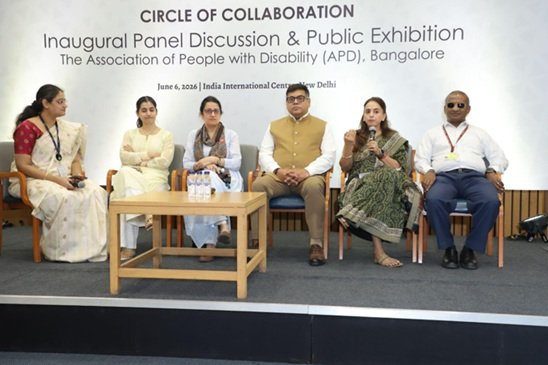
The Association of People with Disability (APD) announced the integration of its flagship Yes to Access (YTA) platform with the Sugamya Bharat App, launched by the Department of Empowerment of Persons with Disabilities (DEPwD), Ministry of Social Justice and Empowerment, Government of India, at the Circle of Collaboration event held at the India International Centre, New Delhi.
 |
APD’s Circle of Collaboration event in New Delhi marked the integration of GoI’s Sugamya Bharat App and Yes to Access
The integration comes at a time when accessibility efforts in India increasingly require more than infrastructure improvements alone. Sustained progress requires collaborative monitoring, stronger accountability, and active participation from governments, civil society organisations, and citizens.
India has – at conservative estimates – 2.68 crore citizens who live with a disability. However, even 10 years after the Rights of Persons with Disabilities (RPwD) Act, public spaces like parks, offices, educational institutions, and restaurants often lack basic accessibility facilities like ramps, wheelchair-friendly toilets. That’s where these apps come in – for regular citizens to audit and report the accessibility of public places. While the Sugamya Bharat App enables citizens to report accessibility barriers and supports the objectives of the Accessible India Campaign, Yes to Access enables citizens to assess and report the accessibility of public spaces at scale, creating a map that helps persons with disabilities, caregivers, families, and allies identify accessible locations.
Together, the platforms aim to strengthen citizen-led accessibility monitoring and create more responsive systems for identifying and addressing barriers faced by persons with disabilities.
The announcement was made during Circle of Collaborations, a convening designed to showcase the power of partnerships in advancing accessibility and inclusion. The event brought together government representatives, disability rights advocates, civil society organisations, accessibility practitioners, designers, and development sector leaders to reflect on progress made and explore pathways for greater collaboration.
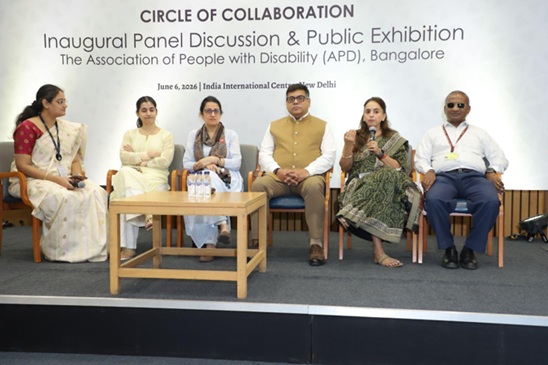
The event was inaugurated by Ms. Manmeet Kaur Nanda, IAS, Additional Secretary, Department of Empowerment of Persons with Disabilities (DEPwD), Ministry of Social Justice and Empowerment, Government of India. The inaugural panel also featured Dr. S. Govindaraj, Chief Commissioner for Persons with Disabilities; Mr. Anand Shekhar, Chief Executive Officer, WaterAid India; and Ms. Puja Anand, President, Association of Designers of India. The session was moderated by Dr. Bhumika Modh, Head – Public Policy and Collaborations, APD, and was preceded by a welcome address from Mr. Jacob Kurian, Honorary Secretary, APD.
The inaugural discussion explored the evolving accessibility landscape in India. Speakers reflected on the importance of data-driven inclusion, public-private collaboration, community-led systems change, and the growing need for stronger standards and capacity-building around digital accessibility.
The event also featured an interactive exhibition showcasing the journey, impact, and future vision of the Yes to Access initiative. Highlights included the Yes to Access Journey Timeline, tracing key milestones and learnings; the Wall of Collaborations, recognising organisations and individuals who have contributed to the accessibility movement; and the Data and Impact Zone, featuring a live dashboard that enabled visitors to engage with accessibility-related insights and outcomes.
The exhibition further included Way Forward, a space dedicated to exploring future opportunities for collaboration and participation, and Postcards to the Future, an interactive installation inviting attendees to share their aspirations and commitments towards a more accessible and inclusive India.
Speaking at the event, Ms. Manmeet Kaur Nanda, IAS, Additional Secretary, DEPwD, said, “Accessibility cannot be achieved by any one institution alone. It requires governments, civil society organisations, industry, and communities to work together towards a common goal. Platforms such as Yes to Access and the integration with Sugamya demonstrate how collaboration and technology can help accelerate our collective journey towards a more inclusive India.”
Dr. Bhumika Modh, Head – Public Policy and Collaborations, APD, said, “The integration of the Sugamya App with Yes to Access is an important milestone in strengthening citizen-led accessibility monitoring and action. Through Circle of Collaborations, we wanted to showcase the power of partnerships in creating sustainable change and invite more stakeholders to join us in building a future where accessibility is embedded by design.”
Ahead of the event, Mr. Jacob Kurian, Honorary Secretary, APD, said, “Through Circle of Collaborations, we wanted to highlight the collective effort that drives progress on accessibility. The exhibition showcases the role of partnerships, innovation, and community participation in creating more inclusive environments. As India continues its digital transformation, ensuring that accessibility is embedded by design will be critical to building a future that works for everyone.“
Circle of Collaborations was envisioned as both a celebration of collective progress and a call for deeper collaboration towards accessible futures that are equitable, participatory, and inclusive by design.
Following the New Delhi edition, Circle of Collaborations will be hosted in Bengaluru on June 13, 2026, at Saanchi Gallery, Bangalore International Centre, bringing together a wider network of partners, practitioners, institutions, and advocates committed to advancing accessibility and inclusion across India.
About The Association of People with Disability
The Association of People with Disability (APD) is a Bengaluru-based non-profit organisation working towards empowering persons with disabilities through inclusive education, livelihoods, skill development, community-based rehabilitation, policy advocacy, and accessibility initiatives. Through collaborative programmes and partnerships, APD works to build equitable and inclusive systems that enable persons with disabilities to participate fully in society.


